
Choose Village Pro if you want to discuss home or business maintenance directly with a local service business; choose BuildZoom if you want to research contractors before deciding whom to approach. This 2026 comparison separates getting a repair scoped from finding a contractor to scope it.
- For my home pro vs buildzoom, choose Village Pro for direct maintenance inquiries and BuildZoom for contractor research.
- BuildZoom is a contractor research platform, not the contractor responsible for your repair.
- Confirm project scope, scheduling, and required qualifications before authorizing work with either route.
- Compare written repair scopes, not a local service business against a platform as though they perform identical roles.
Why this matters
A sticking door, a seasonal upkeep list, and a renovation do not require the same hiring process. Start by deciding whether you need someone to discuss a defined repair or a way to identify contractors for a project that still needs planning.
Village Pro is a DBA of MY HOME PRO LLC, the parent business behind its home and business maintenance and repair services. BuildZoom serves a different role: contractor research and discovery. You are comparing a service business with a way to find service businesses.
That distinction matters more than a general winner label. A useful choice puts you on the right path without confusing an inquiry, a contractor listing, and an agreement to perform work.
At a glance
| Dimension | Village Pro | BuildZoom |
|---|---|---|
| Best for | Direct maintenance and repair inquiries | Researching contractors before making a selection |
| Starting workflow | Describe your property and repair needs to the business | Research contractors, then discuss the project with candidates |
| Contractor comparison | Evaluate one service business | Research different contractor options |
| Local maintenance fit | Focus on The Villages and surrounding Central Florida communities | Assess each contractor's location and service scope separately |
| Seasonal upkeep | Discuss seasonal tasks alongside maintenance needs | Find contractors, then confirm whether they handle the tasks |
| Qualification checks | Confirm requirements for the proposed work | Confirm requirements with the contractor you select |
| Standout feature | Direct discussion of maintenance and repair needs | Contractor discovery and research |
| Pricing model | Project scope and terms confirmed individually | Obtain project terms from the contractor; check any separate platform terms |
Direct service wins for a defined maintenance inquiry
If you already know the problem, a direct inquiry keeps the conversation focused on that problem. Describe what is happening, where it is happening, and what outcome you need. You do not need to begin by building a contractor shortlist.
Village Pro is best for property owners seeking direct discussion of maintenance and repair needs in The Villages area. Its stated work includes home and business maintenance, repairs, and seasonal upkeep. Acceptance of your particular task still requires confirmation.
The limitation is equally clear: approaching one business does not give you a comparison of several contractors. If comparing approaches is part of your decision, contact other suitable businesses separately rather than treating a single inquiry as a market comparison.
For a 2026 maintenance list, separate the work into named tasks. “Bathroom door catches at the top” is more useful than “bathroom needs attention.” Ask which tasks fit the business's scope before discussing a combined visit.
BuildZoom wins for researching contractor options
BuildZoom is the better starting point when your immediate task is finding and researching contractors. That is a different need from asking a known service business whether it can handle a defined repair.
A contractor research platform gives your selection process a place to start. Use it to identify candidates, then ask those candidates about the actual work. A listing is not a project proposal, and research does not establish that a contractor accepts your job.
Best for: owners who want to compare contractor candidates before selecting a business. This route fits a project where you still need to decide who should assess it or how competing contractors would approach it.
The tradeoff is another selection step. You still need to contact candidates, confirm scope, and evaluate their responses. Do not mistake finding a business for securing its agreement to perform the work.
Direct local inquiries win for a Central Florida upkeep list
A direct inquiry is the better fit when the location and maintenance needs are already clear. The stated service focus includes The Villages, Wildwood, Fruitland Park, and surrounding Central Florida communities. Confirm the property's address and the proposed tasks individually.
For a homeowner, that inquiry can describe separate concerns room by room. For a business property owner, it should also explain access restrictions, occupied spaces, and who can approve the work. These details help define the request; they do not establish acceptance or scheduling.
BuildZoom remains useful if your priority is comparing businesses serving the area. You must evaluate each candidate's location, project interests, and scope rather than assuming the platform itself provides local maintenance.
The boundary matters. A local focus does not establish qualifications for every trade, and a nearby address does not prove that a business handles your particular repair. Ask about the task, not just the service area.
BuildZoom wins when contractor selection is the main job
Contractor discovery and repair coordination solve different problems. If you have not decided which business to approach, BuildZoom addresses the selection stage more directly than a single service business's website.
Use contractor research to create a shortlist based on the work you actually need. A contractor suitable for one project is not automatically suitable for a different trade or property type. Keep the project description consistent when contacting candidates.
A useful comparison asks each business to explain:
- What work it proposes to perform.
- What it excludes from the proposal.
- What site assessment or further investigation it needs.
- Who will perform and supervise the work.
- What documentation applies to the agreed scope.
The limitation is that a shortlist still leaves a hiring decision. For a straightforward maintenance inquiry, that research stage adds a step you might not need. For contractor selection, it is the purpose of the exercise.
Direct service wins for discussing seasonal tasks together
Seasonal upkeep is part of the local business's stated offering. That makes a direct conversation a practical starting point when you want to discuss several property-care concerns without first researching separate contractor candidates.
For a 2026 departure or return-home checklist, describe what needs attention and when you expect the property to be occupied. Ask which tasks can be considered together and which require a different specialist. Do not assume one business can handle every item.
Best for: an owner with an existing upkeep list who wants to confirm task fit directly. The advantage is the relevance of the conversation, not a promise that all tasks can be completed together.
BuildZoom fits the earlier stage when you need to identify contractors for that list. Its research role does not itself establish seasonal visits, ongoing monitoring, or a maintenance agreement. Confirm any arrangement with the business that would perform it.
Neither route replaces qualification checks
Both routes require project-specific verification. A direct relationship does not remove the need to check qualifications, and a platform listing does not replace checking the contractor you intend to hire.
This is especially important when a request involves electrical or plumbing work. The service description does not establish licensed trade credentials. Ask what qualifications the proposed scope requires and how the business will address those requirements.
Keep your 2026 hiring check tied to the actual job:
- Identify the business that would perform the work.
- Ask who is responsible for any required permits and inspections.
- Verify applicable credentials through the relevant issuing authority.
- Request documentation relevant to the proposed work.
- Put the agreed scope and exclusions in writing.
Neither side wins this dimension. The right standard is the same: verify the requirements for your project before authorizing it. Do not use a general maintenance label or a contractor profile as a substitute.
Pricing: compare project agreements, not unlike services
A direct service inquiry concerns the work a business proposes to perform. A contractor platform helps with discovery; the eventual contractor's proposal concerns the project itself. Those are different transactions and should be evaluated separately.
For the direct route, project scope, availability, pricing, and scheduling are confirmed individually. For the platform route, obtain the proposed work terms from the contractor and review any separate platform terms before agreeing to them.
Neither route has a supported cost advantage in this comparison. Compare written proposals covering the same tasks, materials responsibilities, exclusions, and approval process. A shorter scope is not equivalent to a fuller one simply because both mention the same room.
If conditions behind a surface remain unknown, ask how additional work would be documented and approved. Predictability comes from a clear agreement; flexibility comes from a defined change process. Neither follows automatically from choosing direct contact or contractor research.
Use this sequence before contacting either option
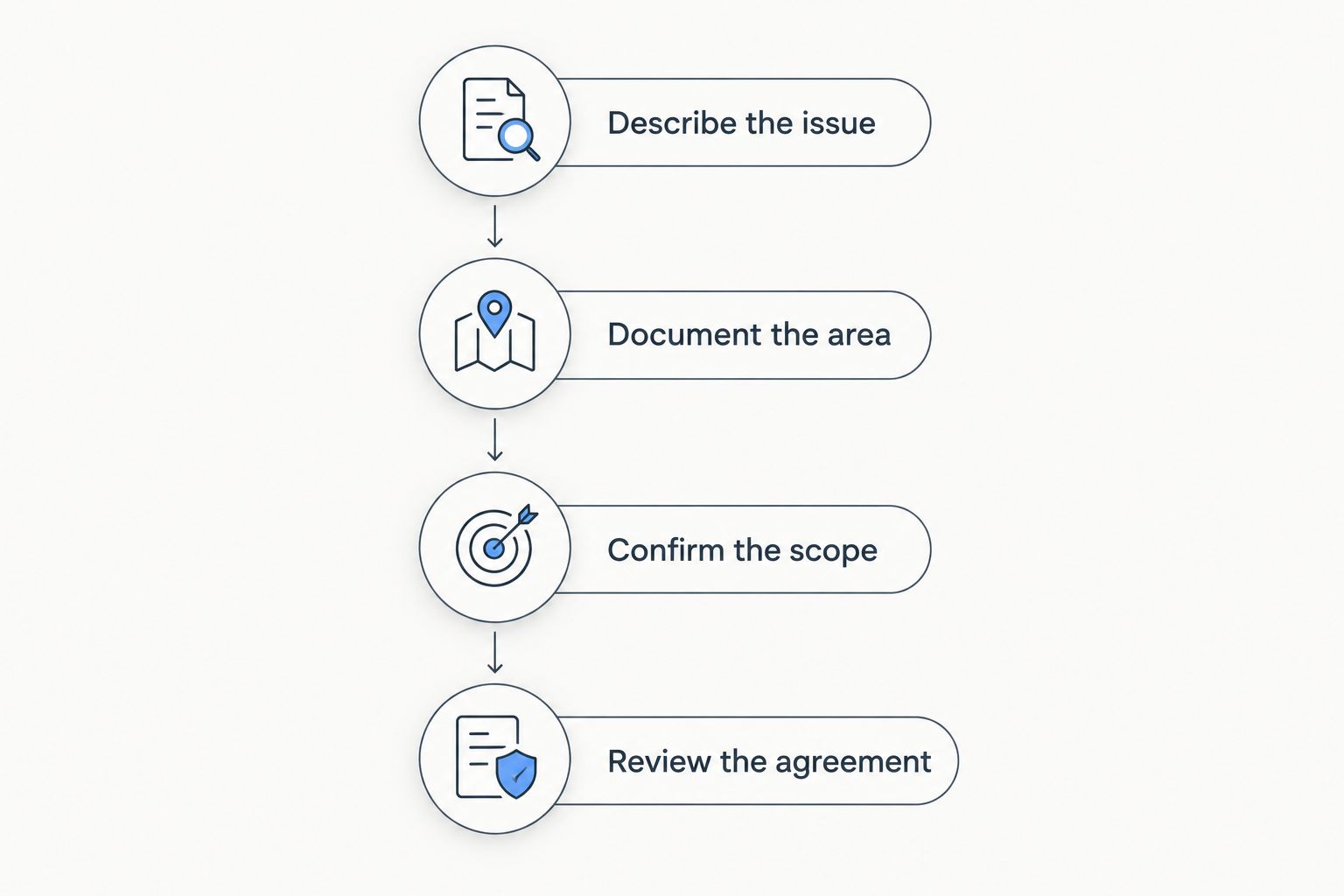
A useful inquiry lets a business assess fit without guessing what you mean. Follow these 4 steps before you send your request:
- Describe the issue. State the location, symptoms, and whether the condition has changed. Avoid diagnosing a concealed cause.
- Document the area. Take 3 useful photos when safe: the wider area, the affected item, and a close view of the visible problem.
- Confirm the scope. Separate the immediate repair from optional improvements. Ask what requires an assessment before a proposal.
- Review the agreement. Check the tasks, exclusions, access arrangements, and approval process before authorizing work.
For a business property, identify the person authorized to approve work. For an occupied home, explain any access needs or areas that must remain usable. These details belong in the initial request, not in assumptions made after work is agreed.
The inquiry form on the local service website prepares an email for you to review and send. Review the message, send it through your email application, and distinguish sending an inquiry from receiving confirmation of a booking.
Final verdict: choose the route that matches your next decision
Choose Village Pro if you need a direct maintenance conversation
Best for: a homeowner or business property owner in The Villages area with a defined maintenance, repair, or seasonal upkeep request. Describe the property and tasks, then confirm scope and scheduling individually. Choose this route when your next question is whether a local service business can address your list.
Choose BuildZoom if you need to select a contractor
Best for: a property owner whose next step is researching and comparing contractor candidates. Use the platform for discovery, then evaluate the businesses against the same project brief. Choose this route when identifying whom to approach is still part of the job.
| Dimension | Winner |
|---|---|
| Defined maintenance inquiry | Direct service |
| Contractor research | BuildZoom |
| Central Florida upkeep discussion | Direct service |
| Comparing contractor candidates | BuildZoom |
| Seasonal task discussion | Direct service |
| Qualification checks | Tie: verify either route |
| Project cost comparison | Tie: compare equivalent written scopes |
FAQ
Is Village Pro the same business as My Home Pro?
Village Pro is a DBA of MY HOME PRO LLC. The parent business is not a separate competitor in this comparison; the service website is villagepro.guru.
Is BuildZoom better for finding a contractor?
BuildZoom is the better fit when your immediate goal is contractor research and discovery. You still need to confirm the selected contractor's scope, qualifications, and proposed agreement.
Which option should I choose for a home maintenance list?
Choose direct service contact when you already have a defined maintenance list and want to discuss task fit. Use contractor research when you still need to identify businesses to approach.
Does a contractor listing prove someone is qualified for my repair?
No, a listing does not replace project-specific verification. Check the qualifications required for the actual work and the business responsible for performing it.
Can I assume electrical or plumbing work is covered?
No, confirm the exact task and required qualifications before authorizing electrical or plumbing work. A general service description does not establish licensed trade credentials.
Does sending the inquiry form book a visit?
No, the form prepares an email for you to review and send. Project scope, availability, pricing, and scheduling are confirmed individually.
How should I compare repair proposals in 2026?
Compare proposals using the same written task list. Check exclusions, materials responsibilities, access arrangements, and the process for approving additional work.
One last thing
Write 2 separate lists: restore function and make improvements. A door that will not close belongs on the first; changing its appearance belongs on the second. Keeping those goals separate makes proposals easier to compare and keeps optional work from obscuring the repair you actually need.