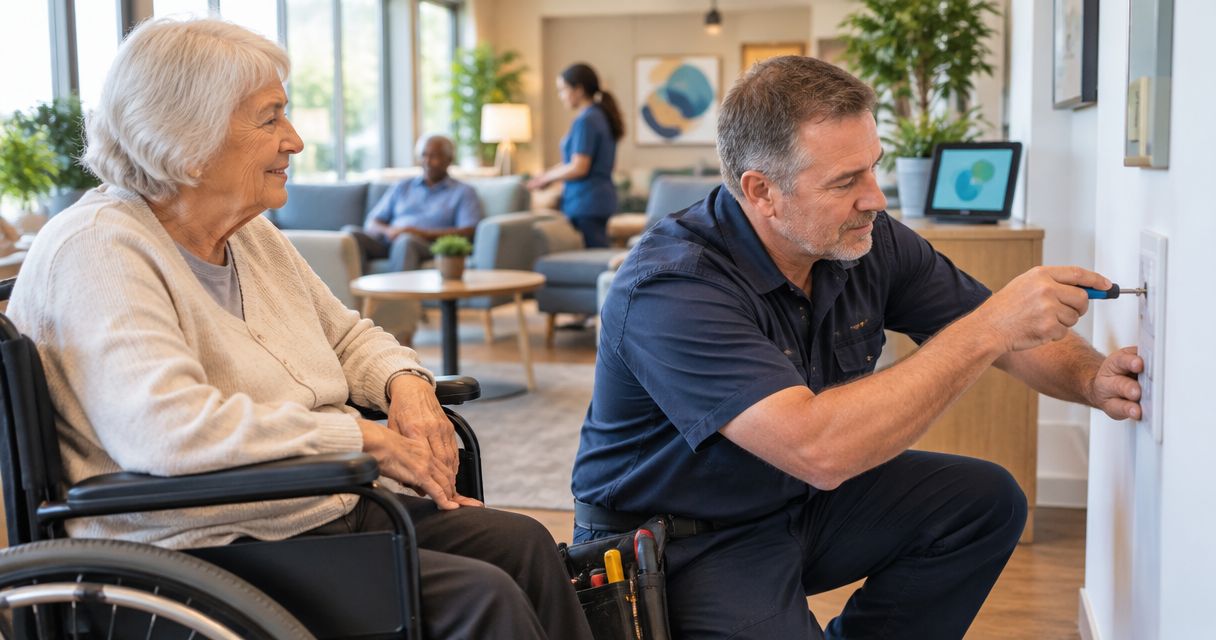
Assisted living facility maintenance is the planned inspection, upkeep, and repair of a residential care property to protect residents and keep essential spaces usable. This 2026 guide explains maintenance for assisted living facilities, where repair decisions must account for mobility, resident privacy, care routines, and safe access—not just the condition of the building.
- Maintenance for assisted living facilities should prioritize resident safety, preventive maintenance, and documented repair follow-through.
- Village Pro offers general property maintenance; confirm each facility project’s scope and scheduling individually.
- Separate routine repairs from work requiring qualified specialists or facility-specific compliance review.
- Close work orders only after checking safe access, cleanup, and the repaired item’s operation.
For local repair inquiries, Village Pro serves home and business property owners in The Villages and surrounding Central Florida communities. Facility operators should describe the building, proposed work, and resident-access restrictions before arranging a project.
Why maintenance matters for assisted living facilities
A loose transition strip is not simply a flooring defect in an assisted living building. It sits in a route used by residents, caregivers, visitors, and mobility equipment. Likewise, a bathroom leak affects both the building and access to a space residents depend on.
Prioritize the effect on residents before the appearance of the defect. A maintenance list organized only by room or repair trade misses the difference between a cosmetic mark and a fault that interrupts everyday care.
For a 2026 maintenance plan in The Villages, Wildwood, Fruitland Park, or nearby communities, include seasonal weather preparation alongside indoor repairs. Roof leaks, drainage problems, and cooling concerns belong in the same reporting system as damaged doors and bathroom fixtures.
The facility’s obligations depend on its license, building systems, and applicable requirements. Use current Florida Agency for Health Care Administration guidance, applicable fire-safety requirements, manufacturer instructions, and qualified professionals to establish mandatory tasks. A general checklist does not replace that review.
How to build an assisted living maintenance plan
1. Map the spaces residents depend on
Start with a paper floor plan and a walk-through with someone who understands daily care routines. Mark bedrooms, bathrooms, dining areas, entrances, staff workspaces, and routes residents use to reach them. Include outdoor paths rather than stopping at the exterior doors.
Record the equipment or building component involved in each observation. A note saying a bathroom needs attention is difficult to assign; a note identifying a loose toilet seat in a particular room gives the repair team a clear starting point.
Use 2 walk-through perspectives: one focused on building condition and one focused on resident access. These are planning recommendations, not prescribed inspection frequencies.
- Mark frequently used resident routes and alternative routes.
- Identify rooms where repairs would interrupt care or meals.
- Record equipment identifiers where labels are accessible.
- Note shutoff locations without operating unfamiliar controls.
- Keep sensitive resident information out of general maintenance records.
2. Sort defects by their effect on safety and care
Use a shared spreadsheet or paper register before buying maintenance software. Assign 3 priority groups: immediate hazards, essential-function problems, and planned upkeep. The groups help staff communicate; they do not establish a universal response deadline.
Immediate hazards require the facility’s safety or emergency procedure, not an ordinary repair appointment. Essential-function problems affect a needed room, fixture, or service. Planned upkeep covers work that can be arranged without leaving a hazard or essential function unresolved.
Keep the action separate from the repair. Restricting access to a damaged area does not fix it, and a scheduled repair does not make an unsafe area usable.
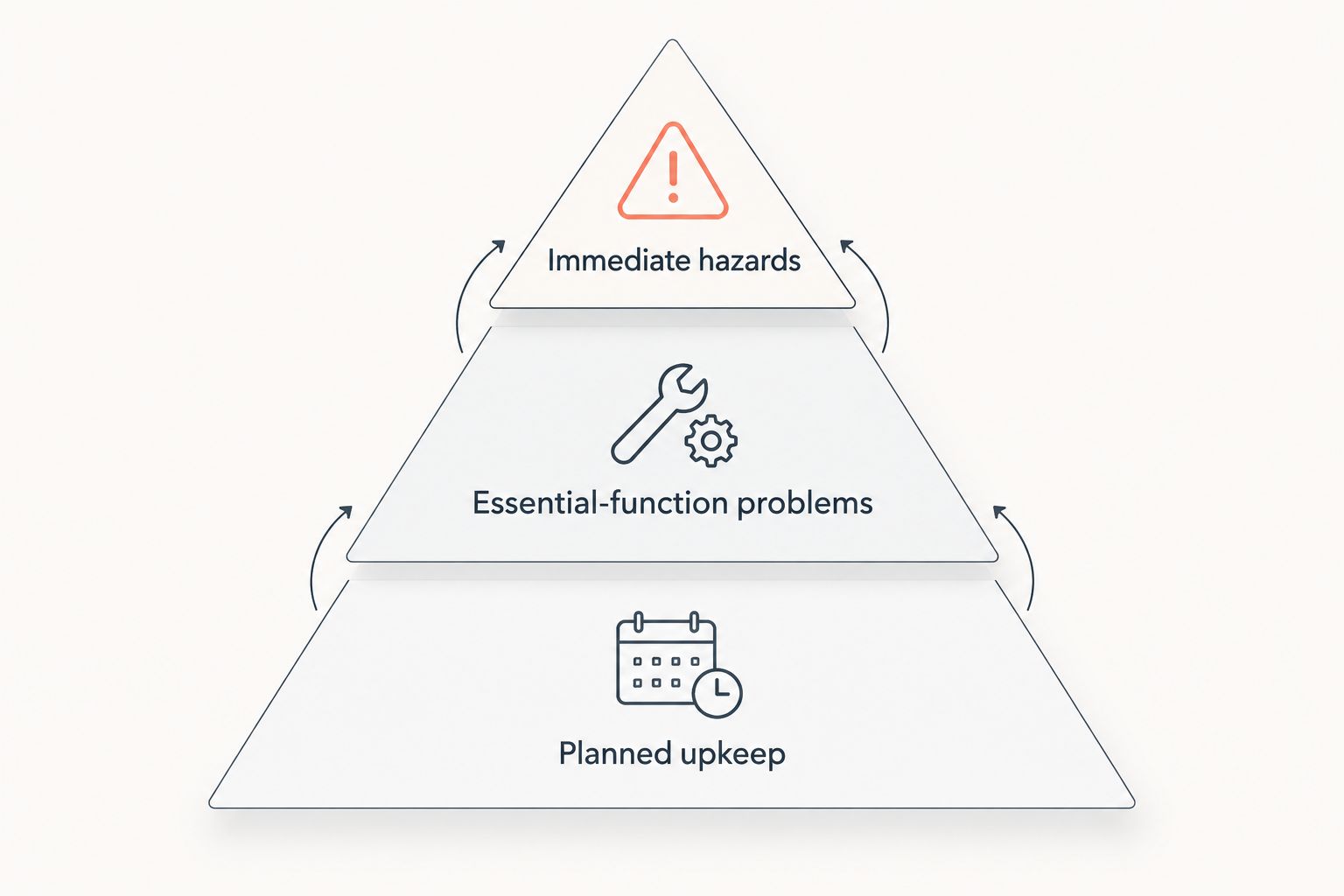
A priority system works only when staff know who receives the report and who authorizes the next action. Give each group a named decision-maker within your facility.
- Follow emergency procedures for immediate danger.
- Record whether an affected space remains usable.
- Identify temporary access arrangements approved by facility staff.
- Assign an owner to every reported defect.
- Escalate unresolved essential-function problems to management.
3. Assign routine work and specialist work separately
Begin with a task list showing what trained facility staff can safely handle within their roles. Then separate general repairs from electrical, plumbing, HVAC, fire-protection, and other work requiring appropriate qualifications or authorization. Do not treat every building problem as a handyman task.
Village Pro maintenance support is best for local property owners seeking help with general repairs. Village Pro is a DBA of MY HOME PRO LLC; individual project scope, availability, pricing, and scheduling are confirmed separately. Do not assume a general maintenance inquiry includes specialist work or an assisted living compliance assessment.
Your 2026 contractor list should identify who assesses each type of fault, who authorizes work, and who verifies completion. The guide to commercial handyman services for property managers provides a related starting point for organizing general repair needs.
- Define the task before choosing a contractor.
- Confirm qualifications required for the specific work.
- Separate repair authorization from facility compliance approval.
- Give contractors access and resident-protection instructions.
- Record exclusions so unfinished work is not overlooked.
4. Build a preventive schedule around actual equipment
Create a simple calendar using equipment manuals, existing service records, and applicable inspection requirements. Do not assign the same interval to every filter, door, drain, or mechanical component. A convenient recurring date is not evidence that the interval fits the equipment.
Group tasks by location when that reduces disruption without delaying required work. For example, coordinate approved bathroom repairs with the facility’s access plan rather than arranging separate visits without checking resident needs.
For the 2026 seasonal calendar, include an exterior review before disruptive weather and a follow-up process after damage reports. Follow official weather guidance and the facility’s emergency plan; maintenance scheduling does not replace either.
- Copy maintenance intervals from the relevant instructions.
- Include required specialist inspections in the same calendar.
- Check doors, flooring, fixtures, and drainage for visible deterioration.
- Assign responsibility for cooling-system service coordination.
- Keep seasonal preparation separate from emergency-response procedures.
5. Write work orders that explain the problem
Use a form or spreadsheet with 4 essential fields: exact location, observed condition, effect on use, and assigned owner. Add photographs when appropriate, without including residents, medical information, or other private material.
Describe what staff observed rather than guessing at the cause. Water beneath a sink is an observation; a failed supply connection is a diagnosis that still needs confirmation. Clear descriptions help the person assessing the problem arrive with the right questions.
Add access restrictions and the facility contact before requesting a visit. A contractor should not have to discover at the doorway that a room is occupied or that a route must remain open.
- Name the room and the specific fixture or component.
- State when staff first noticed the problem.
- Explain whether the condition is recurring or changing.
- Attach relevant images and previous repair references.
- Record who can approve changes to the proposed work.
6. Protect residents during the repair
Plan resident access before tools arrive. Facility staff should decide whether a room can remain occupied, whether an alternative route is suitable, and how residents receive assistance during the work. Contractors need those decisions in clear instructions.
Keep tools, packaging, cords, and debris out of occupied routes. Discuss dust, odors, noise, and cleanup requirements with the facility’s responsible staff. Any infection-prevention measures must follow the facility’s procedures and the work being performed.
A short task still needs a work-area plan. The relevant question is not how quickly someone expects to finish, but whether residents can safely use the surrounding space throughout the job.
- Confirm the work area and approved access route.
- Tell affected staff what will be unavailable.
- Arrange resident movement through the facility’s care team.
- Keep materials secured away from residents.
- Check access and cleanliness before reopening the space.
7. Verify completion and track repeat faults
Do not close a work order because a visit ended. Confirm that the agreed repair is complete, the area is clean, and the affected item operates as intended. Use qualified personnel for checks that require technical expertise.
Keep separate records for the repair and any remaining investigation. A ceiling patch does not close an unresolved leak report. If a fault returns, connect the new report to the earlier work rather than treating it as an unrelated request.
Review recurring defects during your 2026 maintenance meetings. Repetition helps identify where the current repair approach needs reassessment; it does not prove a particular cause without inspection.
- Record the work performed and completion date.
- Attach service documentation and relevant photographs.
- Note checks performed and who performed them.
- Leave unresolved causes open for further assessment.
- Track repeat faults by location and component.
Compare maintenance options for assisted living facilities
Choose a maintenance arrangement by task and accountability, not convenience alone. These options serve different purposes. General repair support does not replace the facility’s responsibility for care coordination, safety decisions, or required specialist inspections.
| Option | Best for | Main benefit | Key limitation |
|---|---|---|---|
| Trained in-house staff | Daily observations and permitted routine tasks | Familiarity with resident routines and building access | Training, workload, and authorization limit the work staff can undertake |
| Village Pro general maintenance | Local owners seeking help with general property repairs | A service inquiry focused on the defined repair need | Scope and scheduling require individual confirmation; specialist capability must not be assumed |
| Qualified trade specialists | Work requiring specific technical qualifications | Assessment and repair within the relevant trade | Separate trades still need coordination with facility staff |
| Maintenance management software | Teams needing shared schedules and work-order records | Central records and assigned tasks | Software does not inspect the property or perform repairs |
A paper system remains a practical starting point when staff consistently record and follow up on work. Software becomes useful when shared visibility or record retrieval is difficult. Neither approach fixes unclear responsibility.
Common mistakes assisted living operators make
Treating resident access as a contractor decision
Contractors need instructions from the facility about occupied rooms, alternative routes, and care routines. Keep resident-movement decisions with the appropriate facility staff. A technically repairable area is not automatically suitable for work while occupied.
Closing the visible defect without investigating recurrence
Repeated staining, recurring drain problems, or a door that keeps binding deserve reassessment. Keep previous work records available so the next person sees the history rather than only the latest symptom.
Using a household checklist as a compliance plan
Residential upkeep advice helps identify ordinary wear, but it does not establish assisted living inspection obligations. Confirm applicable requirements for the specific facility and keep required inspection records separate from informal walk-through notes.
Waiting for a long repair list before reporting hazards
Bundling planned repairs can simplify access, but hazards and essential-function problems need their own escalation process. Do not leave a dangerous condition in place simply because another maintenance visit is being arranged.
FAQ
What does maintenance for assisted living facilities include?
Maintenance for assisted living facilities includes planned inspections, preventive upkeep, repair reporting, contractor coordination, and completion checks. The facility also needs a separate process for applicable safety, licensing, and specialist inspection requirements.
What should an assisted living facility repair first?
An assisted living facility should address immediate danger through its safety procedures before treating the issue as a routine repair. After immediate protective action, prioritize faults affecting essential use, resident access, and care routines.
How often should assisted living maintenance be scheduled?
Maintenance intervals should follow applicable requirements, equipment instructions, and the condition and use of the building. A generic monthly or annual checklist does not establish the correct schedule for every system.
Can a handyman handle all assisted living repairs?
No, a general repair provider is not a substitute for every qualified trade or specialist. Confirm the task, required qualifications, and facility authorization before assigning work.
Is maintenance software necessary for a small facility?
Maintenance software is not necessary to begin a clear work-order process. A shared spreadsheet or paper register works when someone owns each task, updates its status, and retains completion records.
How should facility staff prepare for a maintenance visit?
Facility staff should provide the exact location, observed problem, access restrictions, and an authorized contact. Agree on resident protection, work-area controls, and reopening checks before work begins.
How do I request general maintenance help from Village Pro?
Describe the proposed work through the service website’s inquiry process. The inquiry form prepares an email for you to review and send; project scope, availability, pricing, and scheduling are confirmed individually.
One last thing
A completed repair and a closed maintenance problem are not always the same thing. Before closing a recurring issue, check that the record explains what was repaired, what remains unresolved, and who owns the next action. That distinction keeps a tidy work-order list from hiding an unfinished problem.