
Choose Village Pro if you want to discuss a home or business maintenance job directly with a local service business; choose Yelp if you want to compare businesses before deciding whom to contact. The my home pro vs yelp comparison is about hiring a provider versus researching providers—not choosing between two repair companies.
- For my home pro vs yelp, choose direct service inquiries when your maintenance job is already defined.
- Choose Yelp to compare business listings, customer reviews, and photos before building your shortlist.
- Village Pro is a DBA of MY HOME PRO LLC, not a separate competitor to its parent business.
- Confirm project scope and scheduling individually; a listing or inquiry does not establish an accepted job.
Why this matters
A repair provider and a business directory solve different problems. One gives you a business to approach about the work; the other helps you decide which businesses deserve that conversation. Mixing those roles makes it harder to judge what each option actually offers.
For homeowners in The Villages, Wildwood, Fruitland Park, and surrounding Central Florida communities, the next move starts with a simple question: are you ready to discuss a particular job, or are you still choosing a provider? The same distinction applies to a commercial property owner arranging maintenance around tenants, customers, or staff.
For your 2026 maintenance planning, separate discovery from booking. Reading a review, submitting an inquiry, and agreeing on a scope are different stages. None replaces the next.
At a glance
| Dimension | Village Pro | Yelp |
|---|---|---|
| Best for | Owners ready to discuss local maintenance or repair work | Owners comparing businesses before contacting them |
| Relationship | Direct conversation with a service business | Research across business listings |
| Standout feature | Home and business maintenance focus | Customer reviews and business discovery |
| Comparison breadth | Evaluate one business against your job | Compare several businesses against your criteria |
| Project definition | Discuss the requested work directly | Research first, then confirm scope with providers |
| Credentials and safety | Check requirements for the specific work | Check requirements with the business you select |
| Scheduling | Confirm individually with the business | Confirm with the selected provider, not the directory |
| Pricing model | Project terms require individual confirmation | Separate directory research from the provider's proposal |
Direct service wins when you already know the job
Village Pro is best for local property owners ready to discuss a maintenance or repair job directly. Its stated focus is home repairs and improvements, property and facility maintenance, and seasonal upkeep. MY HOME PRO LLC is the parent business; the service brand is its DBA.
That direct route suits an owner who can explain the problem and wants to establish whether the business can handle it. You do not need another comparison page to describe a sticking door, report a maintenance concern, or ask about seasonal upkeep. You need a scope conversation.
The limitation is equally clear: contacting one provider does not compare the market for you. You still need to decide whether the proposed work, communication, and scheduling fit your property. A direct inquiry is a starting point, not proof that every requested task is accepted.
Yelp fits an earlier stage. If you have not chosen whom to approach, its directory format gives you businesses to investigate rather than one business to evaluate in isolation.
Yelp wins for reviewing several businesses
Yelp is the better option when your immediate task is building a shortlist. Its business listings, customer reviews, and photos support comparison across providers. That is useful when you want to understand how different businesses describe their work and how customers describe their experiences.
Read for relevance rather than treating every review as equally useful. A comment about a small residential repair does not answer every question about maintaining a commercial property. Look for discussion of work resembling yours, then verify the details directly with the business.
The drawback is additional selection work. You must decide which listings match the job, which reviews provide useful context, and which questions remain unanswered. Yelp helps you research; it does not replace your judgment about the provider.
For a 2026 shortlist, use the same criteria for every business. Comparing one provider's detailed explanation with another provider's headline rating is not a like-for-like assessment.
Direct contact wins for explaining property constraints
A direct conversation is better once access, scope, and property use become the main questions. A provider needs more than a task name to understand what you are asking. The location of the issue, visible symptoms, and access restrictions all belong in the discussion.
For a home, explain whether someone will be present and whether the affected space is occupied. For a business property, describe customer access, tenant arrangements, and any work areas that cannot be interrupted without approval. These details help define the request without assuming the business has accepted your preferred arrangement.
Use these 4 details in your first inquiry:
- Problem: Describe what you observe, not an assumed diagnosis.
- Location: Identify the affected room, fixture, or property area.
- Access: Explain who can provide entry and any restrictions.
- Requested outcome: State what you want repaired, checked, or discussed.
Yelp remains useful for finding candidates. Its limitation at this stage is that public listing information cannot settle the details of your particular property. Those details still need a provider conversation.
Yelp wins on breadth, not job-specific certainty
Yelp offers a broader comparison path; a direct inquiry offers a narrower, more specific conversation. Choose breadth when you want alternatives. Choose specificity when you already have a business in mind and need to determine whether the work fits.
This is the central tradeoff in the my home pro vs yelp decision. A directory lets you examine multiple businesses, but you remain responsible for checking their suitability. A direct service website reduces the number of businesses in the conversation, but it does not establish that this provider is the right match for every task.
Do not use the number of options as a substitute for a clear brief. If you describe the job differently to each business, the responses will be difficult to compare. Keep the property details and requested outcome consistent.
For your 2026 repair list, separate unrelated needs before choosing a route. A general maintenance request and work requiring a particular trade qualification deserve different screening questions, even when they concern the same property.
Both routes need a defined scope before work starts
Neither route wins on scope without an actual agreement. A business description tells you what to ask about; it does not define the work at your address. A review describes another customer's experience, not the boundaries of your project.
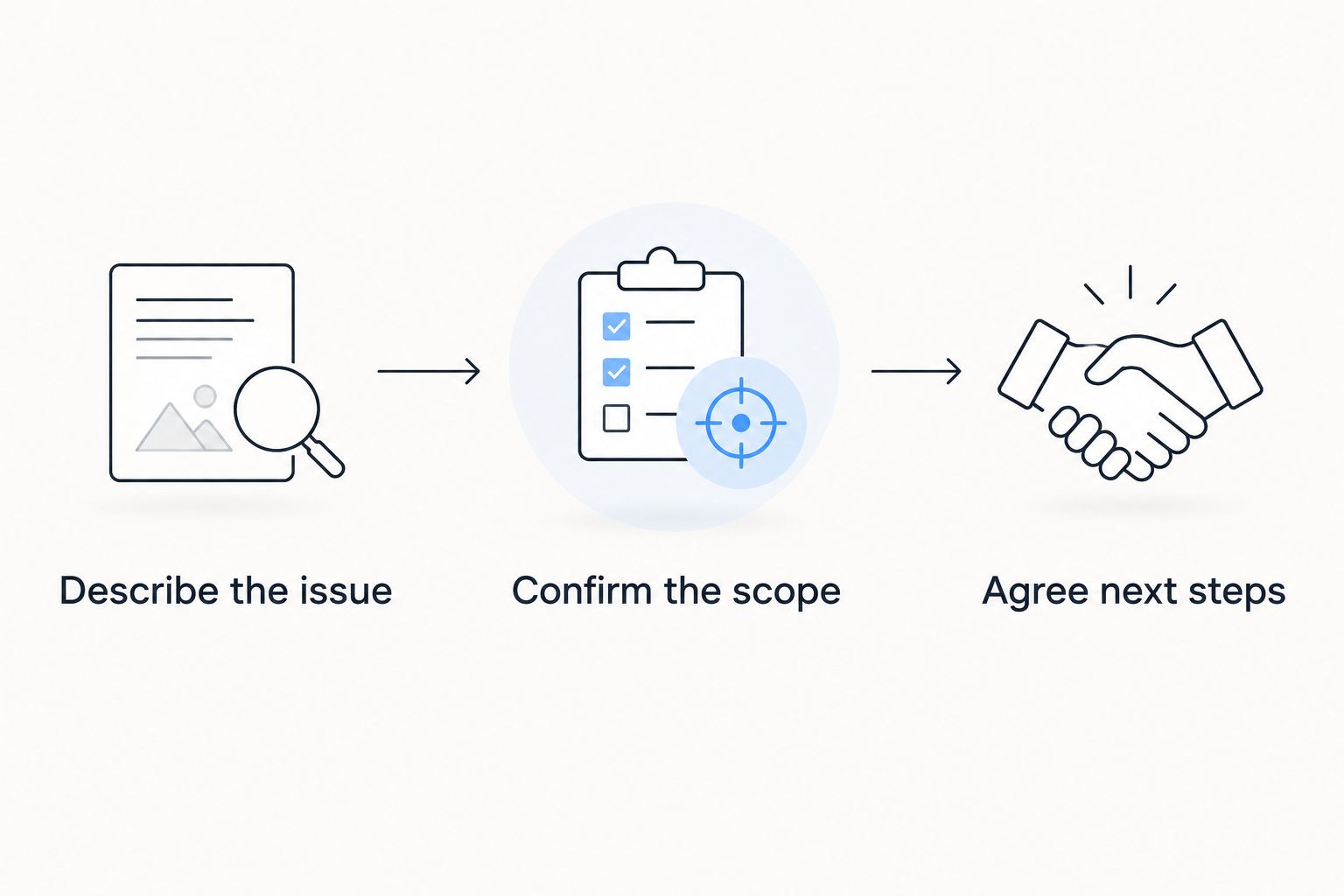
Use a 3-step handoff from research to a service discussion:
- Describe the issue. Record visible symptoms and provide useful photos where appropriate.
- Confirm the scope. Ask what work is included, what is excluded, and what needs further assessment.
- Agree next steps. Confirm who authorizes the work and how scheduling will be arranged.
A useful request might describe a door that catches at the frame and ask for assessment and repair options. That is clearer than requesting a replacement before the cause has been checked. Keep observations separate from conclusions.
Both routes require task-specific safety checks
Neither a directory listing nor a service description replaces credential checks. For work requiring a licensed trade, verify the applicable requirements and the qualifications of the person or business doing that work. Do not infer those qualifications from a broad maintenance description.
This matters when a repair request touches plumbing or electrical systems. Describe the concern, ask whether it falls within the provider's confirmed scope, and establish whether another qualified professional is needed. Do not turn an online comparison into permission to attempt hazardous work yourself.
Review content is not a substitute for that confirmation. Neither are photographs, a familiar business name, or an appealing description of services.
For 2026 property planning, keep safety questions separate from convenience questions. A convenient appointment does not establish task suitability, and a positive review does not answer every qualification question.
Scheduling is a tie until a provider confirms it
Neither route establishes a work date by itself. Project scope, availability, pricing, and scheduling are confirmed individually. A preferred date in an inquiry remains a request until the business confirms the arrangement.
For seasonal residents, explain any travel dates and access arrangements early. For commercial properties, identify who can authorize entry and whether work must be coordinated with tenants or staff. These are planning details, not promises of a particular appointment.
The inquiry form on the service website prepares an email for you to review and send. Completing the form alone is not the same as sending the message, and sending the message is not a confirmed booking.
Yelp research also requires a handoff. Once you select a business, confirm the actual appointment arrangements with that provider rather than relying on the existence of a listing.
Pricing: compare project terms, not the directory with the repair
Separate the research route from the work proposal. A service business discusses the requested job; Yelp helps you research businesses. Those are not equivalent purchases, so comparing them as though they offer the same repair package creates a false choice.
Ask each prospective provider how the work will be assessed, what the proposal includes, and how changes will be approved. Do not assume a fixed project arrangement, an hourly arrangement, or a recurring plan unless the business confirms it.
Defined scope gives you a clearer basis for comparing proposals. Unresolved conditions need an agreed process for assessment and changes. That distinction matters more than attaching a familiar label to an unconfirmed pricing model.
For your 2026 maintenance decisions, compare the same requested outcome across providers. A proposal that excludes an important task is not equivalent to one that includes it.
Final verdict: choose your next step, not a universal winner
Choose Village Pro if you are ready for a service conversation
Best for: a local homeowner or business property owner with a defined maintenance request. Choose this route when you want to describe the issue directly and confirm whether the work fits the business's scope. Keep your expectations specific: the inquiry begins a discussion about the project, not an automatic commitment.
Choose Yelp if you are still selecting a provider
Best for: an owner who wants to compare businesses before making contact. Choose Yelp when reviews, photos, and alternative listings will help you build a shortlist. Its weakness is that you still need to verify scope, qualifications where required, and appointment arrangements with the selected business.
| Dimension | Winner |
|---|---|
| Defined local maintenance request | Direct service inquiry |
| Researching customer experiences | Yelp |
| Explaining property constraints | Direct service inquiry |
| Comparing multiple businesses | Yelp |
| Establishing project scope | Tie: provider confirmation required |
| Checking task-specific qualifications | Tie: verification required |
| Confirming scheduling | Tie: provider confirmation required |
| Evaluating project terms | Tie: compare actual proposals |
FAQ
Is My Home Pro better than Yelp for home repairs?
A direct service inquiry is better when you already know whom you want to approach about a repair; Yelp is better when you are still comparing businesses. One is a provider route, while the other is a business-research route.
Are Village Pro and MY HOME PRO LLC different companies?
Village Pro is a DBA of MY HOME PRO LLC. Treat the former as the service brand and the latter as the parent business, not as competing repair providers.
Does Yelp carry out the maintenance work?
Yelp is a business-discovery and review platform, not the maintenance provider in this comparison. Confirm the work and its terms with the business you select.
Does completing the inquiry form send my request?
The service website's inquiry form prepares an email for you to review and send. Review the message and send it; completing the form alone does not establish a booking.
What should I send when asking about a repair?
Send a description of the visible problem, its location, access details, and your requested outcome. Include useful photos where appropriate, and avoid presenting an unconfirmed diagnosis as fact.
Can I assume plumbing or electrical work is covered?
No, confirm the exact task and any required qualifications before arranging work. A general maintenance description does not establish licensed trade capability for a particular project.
Should I read reviews before contacting a local maintenance business?
Read reviews when they help you assess relevant customer experiences, then ask the business your project-specific questions. Reviews cannot confirm the scope or scheduling of your own job.
One last thing
Write the repair brief before opening another review page. A clear description makes both routes more useful: you can screen directory listings against the actual need and give a provider something concrete to assess. Save that same brief for every conversation so you compare answers to the same request.