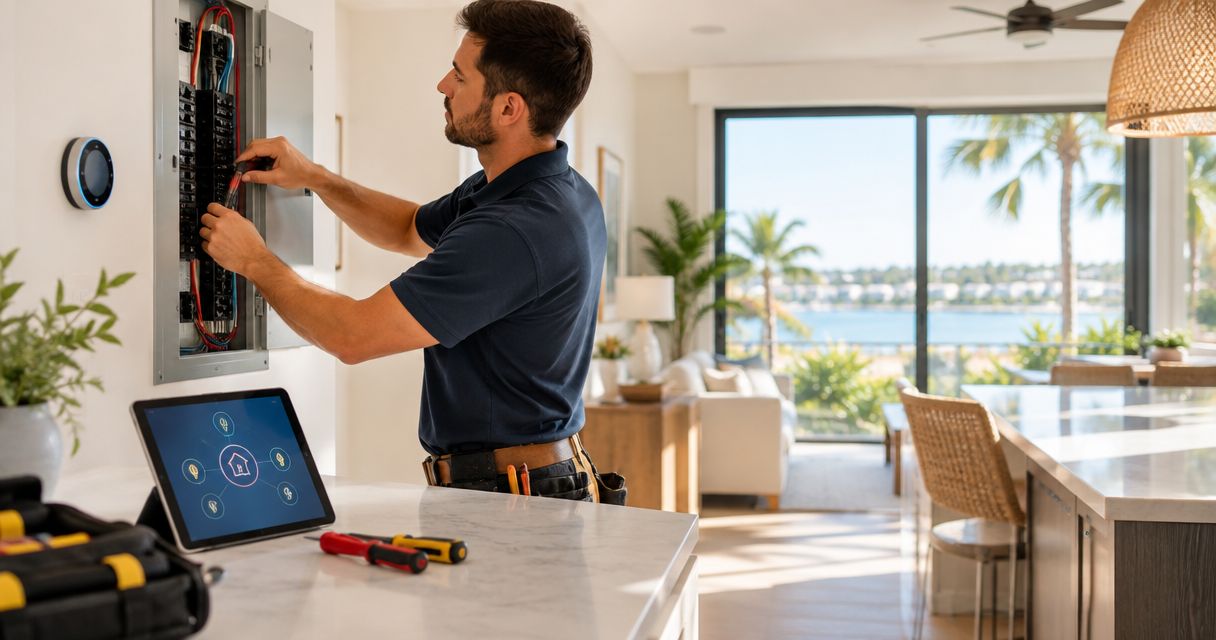
Best overall: whole-home surge protection, once existing electrical hazards are corrected. Best for wet areas: GFCI protection; best for nighttime visibility: better lighting and accessible controls. This 2026 guide ranks the best electrical upgrades Florida homes need by the problem each upgrade solves—not by how much equipment you can add.
- The best electrical upgrades Florida homes need start with correcting hazards, then adding surge and shock protection.
- Whole-home surge protection is the default upgrade for an otherwise sound electrical system, not a substitute for repairs.
- GFCIs address ground-fault shock risks; AFCIs address arcing risks. Neither replaces the other.
- Myhomeprousa provides electrical maintenance services for residential and commercial property owners in The Villages, FL.
Why this matters
Florida homeowners have to plan around storms, outdoor electrical use, and equipment operating near moisture. An upgrade should address a specific exposure or limitation. Adding devices without checking the existing wiring leaves the underlying problem untouched.
Myhomeprousa offers electrical and other property maintenance services in The Villages, FL. Myhomeprousa is a fit for local property owners seeking electrical maintenance alongside plumbing and seasonal upkeep.
Active faults come before improvements. Burning smells, scorched outlets, shocks, or repeated breaker trips call for professional evaluation—not a new light fixture or a larger breaker. Start with these electrical safety checks for older Villages homes if you are unsure what needs attention first.
What makes the best electrical upgrades for Florida homes?
Use these criteria to judge your 2026 project list before choosing equipment:
- Risk addressed: Identify whether the work targets shock, arcing, surges, overloads, or poor visibility.
- Existing condition: Confirm that damaged wiring, loose connections, and faulty devices are addressed first.
- System compatibility: Match protective devices, circuits, and controls to the actual panel and wiring.
- Daily usefulness: Favor improvements that solve a recurring problem in how you use the home.
- Maintenance needs: Understand testing, indicator lights, weather exposure, and replacement instructions.
- Project requirements: Confirm applicable permits, inspections, and who is qualified to perform the work.
Do not treat this ranking as a mandatory shopping list. A missing safety device outranks a convenience improvement, regardless of its position below.
Electrical upgrades at a glance
| Rank | Upgrade | Best for | Standout function | Key limitation |
|---|---|---|---|---|
| 1 | Whole-home surge protection | Incoming surge protection | Protects at the electrical distribution level | Does not prevent outages or guarantee protection from lightning |
| 2 | GFCI protection | Wet-area shock protection | Interrupts ground-fault current | Does not correct damaged wiring |
| 3 | AFCI protection | Arc-fault protection | Detects certain hazardous arcing conditions | Requires compatibility and circuit evaluation |
| 4 | Dedicated circuits and capacity planning | Added electrical loads | Matches circuit provision to equipment needs | A new circuit does not increase service capacity |
| 5 | Outdoor receptacle and cover upgrades | Exposed outdoor connections | Improves suitability for weather exposure | Covers alone cannot fix defective wiring |
| 6 | Generator transfer equipment | Planned backup power | Separates utility and generator sources | Requires a compatible backup-power plan |
| 7 | Lighting and accessible controls | Nighttime movement | Places useful light where you need it | Does not address circuit protection |
1. Whole-home surge protection: best for incoming surges
Whole-home surge protection belongs near the top of a 2026 improvement plan when the home's electrical system is otherwise sound. A surge protective device limits transient overvoltage; it does not supply electricity during an outage.
An electrician should check the panel, grounding and bonding arrangements, and device installation requirements. Sensitive equipment can also need coordinated protection at its point of use. One protective device is not a promise that every connected appliance will survive every event.
Whole-home surge protection pros:
- Addresses surges at the electrical distribution level.
- Adds protection beyond individual power strips.
- Can form part of a coordinated protection plan.
Whole-home surge protection cons:
- Does not provide backup power.
- Does not guarantee protection against a direct lightning strike.
- Requires attention to the device's status and replacement instructions.
Best for: Owners who want surge protection across an otherwise serviceable electrical system.
Ask where the status indicator will be visible and what signals a need for replacement. A device you cannot readily check is harder to maintain.
Verdict: Buy after existing faults are corrected and installation compatibility is confirmed.
2. GFCI protection: best for wet-area shock protection
Ground-fault circuit interrupter protection reduces shock risk by interrupting power when it detects an imbalance between outgoing and returning current. Bathrooms, kitchens, garages, and outdoor locations deserve particular attention during an assessment.
GFCI protection can come from a receptacle or a circuit breaker. The correct arrangement depends on the circuit, existing equipment, and applicable requirements. A standard breaker and a GFCI perform different jobs.
GFCI protection pros:
- Addresses ground-fault shock hazards.
- Can protect downstream receptacles when correctly installed.
- Provides test and reset functions for checking operation.
GFCI protection cons:
- Does not repair damaged conductors or loose connections.
- A trip requires investigation rather than repeated resetting.
- Downstream protection can make the reset location less obvious.
Best for: Homes with missing, faulty, or uncertain wet-area protection.
Have the installer identify which outlets each device protects. Follow the manufacturer's testing instructions, and keep reset locations accessible rather than hidden behind stored belongings.
Verdict: Buy where required protection is absent or defective; prioritize this over convenience upgrades.
3. AFCI protection: best for arc-fault protection
Arc-fault circuit interrupters detect certain electrical arcing conditions that can create a fire hazard. They serve a different purpose from GFCIs, which address ground-fault shock risks.
For a 2026 assessment, ask an electrician which circuits require AFCI protection and whether the existing wiring supports the proposed approach. A breaker change is not a substitute for tracing a recurring fault. Some devices combine AFCI and GFCI functions, but the required protection still needs to be identified.
AFCI protection pros:
- Adds protection against certain hazardous arcing conditions.
- Addresses risks beyond ordinary overload protection.
- Can complement GFCI protection where both are needed.
AFCI protection cons:
- Does not detect every possible electrical fault.
- Existing wiring arrangements can complicate installation.
- Repeated trips need diagnosis, not removal of the protection.
Best for: Owners assessing arc-fault protection during electrical repairs or alterations.
Tell the electrician which appliances were operating when a trip occurred. That observation is useful; guessing that the protective device is defective is not.
Verdict: Buy when the circuit assessment supports it; hold any breaker-only change without diagnosis.
4. Dedicated circuits: best for added electrical loads
A dedicated circuit supplies equipment without sharing that branch circuit with unrelated loads. It is useful when adding equipment with specific circuit requirements or correcting an arrangement that overloads an existing circuit.
Standard household receptacle circuits commonly supply 120 volts, while some larger household equipment uses 240 volts. Voltage alone does not tell you whether the panel, service, wiring, or protective device can support an addition. Equipment instructions and a load calculation guide that decision.
Dedicated circuit pros:
- Matches circuit provision to equipment requirements.
- Reduces inappropriate sharing of a branch circuit.
- Supports planned additions rather than extension-cord workarounds.
Dedicated circuit cons:
- Does not automatically increase the home's service capacity.
- Installation can require access through finished surfaces.
- Available breaker space does not prove available capacity.
Best for: Owners adding equipment or resolving a confirmed circuit-capacity problem.
List planned additions together before requesting work. Assessing them as one project avoids designing a circuit for today's appliance while ignoring the next addition.
Verdict: Buy after a load assessment; skip an automatic panel replacement based only on age.
5. Outdoor electrical upgrades: best for exposed connections
Outdoor electrical work should address the receptacle, enclosure, cover, wiring, and required protection as a system. Replacing a cracked cover helps only if the equipment behind it is also sound and suitable for the location.
Ask for an assessment of patio, porch, exterior-wall, and other outdoor outlets you actually use. Equipment must suit its exposure, including whether a cord remains plugged in. Water entry, corrosion, and loose mounting need correction rather than cosmetic concealment.
Outdoor electrical upgrade pros:
- Addresses weather exposure at connection points.
- Improves access to suitably located outdoor power.
- Creates an opportunity to check GFCI protection.
Outdoor electrical upgrade cons:
- A new cover cannot repair deteriorated wiring.
- Equipment must match the location and intended use.
- Outdoor installations still need periodic inspection.
Best for: Homes with damaged outdoor fittings or poorly located outdoor power.
Show the electrician where you use lighting and maintenance equipment. A conveniently placed permanent receptacle is a better planning goal than making an extension cord part of the landscape.
Verdict: Buy when exposure or damage warrants correction; skip appearance-only replacements.
6. Generator transfer equipment: best for planned backup power
Generator transfer equipment provides a controlled way to separate utility power from generator power. Never connect a portable generator to a household receptacle to feed the home; that creates dangerous backfeeding.
Choose the backup loads before choosing the connection arrangement. Refrigeration, lighting, and other selected equipment impose different demands from trying to power everything. Installation must account for the generator, electrical system, and applicable requirements.
Generator transfer equipment pros:
- Provides an intentional separation between power sources.
- Supports a defined list of backup loads.
- Replaces improvised generator-to-house connections.
Generator transfer equipment cons:
- Does not increase the generator's output.
- Requires compatible equipment and professional installation.
- Does not solve generator exhaust or fuel-storage hazards.
Best for: Owners who have a defined generator backup plan.
For 2026 storm planning, follow CDC portable-generator safety guidance: operate generators outside, at least 20 feet from doors, windows, and vents. A garage is not a safe operating location, even with the door open.
Verdict: Buy as part of a complete backup plan; skip improvised connections entirely.
7. Lighting and accessible controls: best for nighttime movement
Useful lighting puts light on the route you travel, not just in the center of a room. Review entrances, hallways, bathrooms, steps, and switches you have to reach in darkness.
LED fixtures, compatible dimmers, and occupancy controls are options, not interchangeable answers. Select them around the task. A control that switches off while someone is still using the space needs a different setup.
Lighting and accessible control pros:
- Improves visibility on frequently used routes.
- Places controls where you can reach them.
- Can reduce dependence on temporary plug-in lighting.
Lighting and accessible control cons:
- Excessive brightness can create glare.
- Lamps and dimmers need compatibility checks.
- Automatic controls can behave poorly in unsuitable locations.
Best for: Owners who want easier nighttime movement and more practical control locations.
Walk the home after dark before specifying fixtures. Note shadows, reflections, and places where a door blocks a switch. Those observations are more useful than choosing brightness alone.
Verdict: Buy after safety work; skip fixture changes that leave the same visibility problem.
How these electrical upgrades are ranked
The ranking favors broad protective value, then specific circuit needs, outdoor exposure, backup planning, and convenience. It is a decision guide—not a claim that every Florida home needs every upgrade.
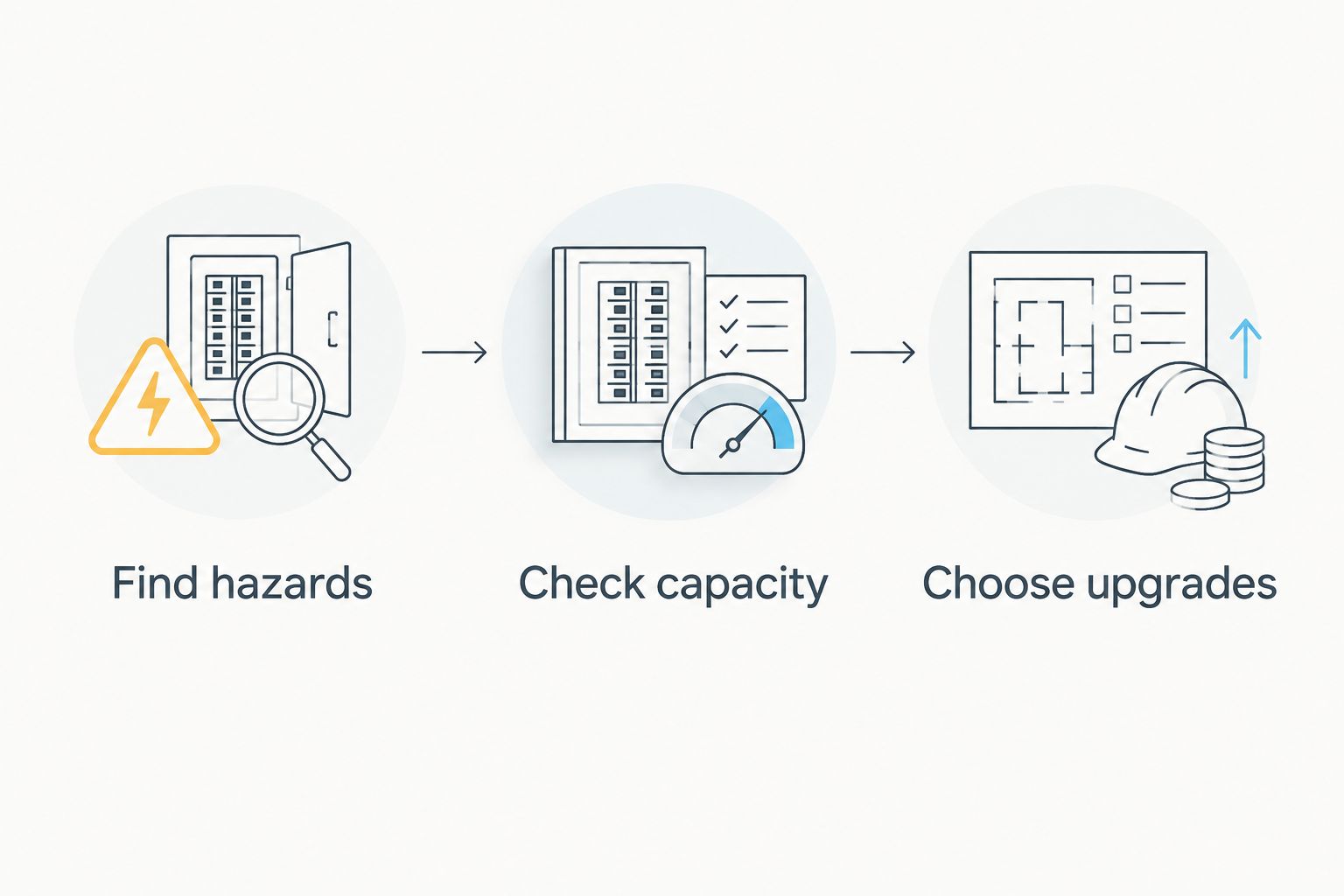
Use this sequence when reviewing recommendations:
- Find hazards: Identify active faults and missing protection.
- Check capacity: Evaluate the existing system and planned loads.
- Choose upgrades: Match each project to a documented need.
Keep the written scope specific. It should distinguish diagnosis, repair, protective devices, and new equipment so you understand what the proposed work actually resolves.
Which electrical upgrades should you choose?
Choose whole-home surge protection as the default addition only after confirming the existing system is sound. Move missing GFCI protection, damaged outdoor equipment, or active faults ahead of that recommendation when your inspection identifies them.
For your 2026 plan, request a prioritized scope rather than an undifferentiated list. Separate necessary repairs from equipment additions and comfort improvements. Myhomeprousa offers electrical maintenance within its home and business maintenance services in The Villages, FL.
Discuss your electrical maintenance needs
Share the faults, outdoor exposure, and planned equipment additions you want assessed.
FAQ
What's the best electrical upgrade for a Florida home?
Whole-home surge protection is a strong default addition when the existing electrical system is sound. Active faults and missing required safety protection take priority over that addition.
Is a GFCI better than an AFCI?
GFCIs and AFCIs address different hazards, so neither replaces the other. GFCIs address ground-fault shock risks, while AFCIs detect certain hazardous arcing conditions; some circuits need both forms of protection.
Does every older Florida home need a new electrical panel?
Age alone does not establish that a panel needs replacement. An electrician should assess condition, equipment compatibility, existing loads, and planned additions before recommending replacement.
Can whole-home surge protection keep the power on during a storm?
No, surge protection does not supply electricity during an outage. Backup power requires a separate system and a safe connection arrangement.
Can I solve repeated breaker trips with a larger breaker?
Do not increase breaker size to stop unexplained trips. The circuit needs diagnosis, and breaker sizing must match the conductors and equipment requirements.
What should I check before adding outdoor outlets?
Check the proposed location, weather exposure, circuit capacity, required GFCI protection, and suitable enclosure and cover. Damaged existing wiring needs repair rather than concealment behind a new fitting.
Does Myhomeprousa offer electrical maintenance in The Villages?
Myhomeprousa offers electrical maintenance and repair services for residential and commercial property owners in The Villages, FL. Its stated services also include plumbing and seasonal upkeep.
One last thing
A power strip is not necessarily a surge protector. Extra outlets and surge protection are separate functions; check the device's labeling rather than its appearance. Bring that same discipline to permanent upgrades: name the problem first, then choose equipment that addresses it.